|
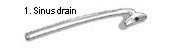
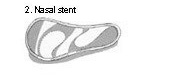
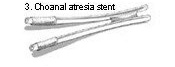
1. Maxillary and frontal sinus Berkodrain The drain is made of medical grade silicone-rubber, impregnated with medical grade dimethylpolysiloxane oil 350 centiStokes. Length of the Berkodrain: appr. 100 mm. Outside diameter: 6.3 mm. The drain is used for the surgical treatment of chronic sinusitis, especially indicated in chronic frontal sinusitis. In cases of obstruction of the naso-frontal duct, after surgical enlargement of the duct, the drain can be left in place for two to three weeks. Due to the absolute atoxicity of the material, combined with excellent properties of the surface of the drain (being boundary and weeping lubricated), the recovery of the damaged mucous membrane of the naso-frontal duct will usually take place without (excessive) scar-tissue formation. If there is reason to believe that intubation of the duct would take more than three weeks (nasendoscopic control), a new Berkodrain has to be introduced. After three weeks the beneficial effects of boundary and weeping lubrication are depleted and microorganisms (candida albicans) are growing into the micro-porous material of the drain wall. The drain is also useful in the treatment of maxillary sinusitis and of pharyngeal and retro-tonsillary abscesses, introduction through a small stab-wound incision. 2. Lubrelastic nasal stent The nasal stent is made of medical grade silicone-rubber, impregnated with medical grade dimethylpolisyloxane oil 350 centiStokes. Indications for use: After nasal surgery and after laceration of the nasal mucous membrane due to (surgical) trauma. The stents have to be positioned on both sides of the nasal septum, if synechiae have to be avoided. Due to the absolute atoxicity of the material, combined with the property of boundary and weeping lubrication of the stent, due to the impregnation with silicone oil, healing of the mucous membrane will take place rapidly. The development of adhesions is thus avoided. If adhesions already exist, separation and introduction of a nasal stent will be helpful. If treatment with nasal stents takes longer then three weeks, the stent should be replaced, because the beneficial effects of boundary and weeping lubrication are then depleted and microorganisms (candida albicans) are growing into the micro-porous material of the stent. 3. Choanal atresia twin Berkotube The choanal atresia twin berkotube is made of medical grade silicone-rubber, impregnated with medical grade dimethylpolisiloxane oil 20/350 centiStokes. There are three sizes, small/medium/large, accommodating most cases of congenital choanal atresia, from neonates to age 8 years. Other dimensions of the twin tube can be manufactured custom-made to the design of the user. Introduction mostly after endonasal operation of the atresia, from the first week after birth in bilateral cases to any convenient time of operation. (Success of the operation depends also on the removal of the posterior 2-3 mm of the vomer.) Due to the absolute atoxicity of the material, combined with the property of boundary and weeping lubrication of the tube which is due to the impregnation with silicone oil, healing of the mucous membrane will take place without formation of excessive granulation's. The tube should be changed after three weeks, because the beneficial effects of boundary and weeping lubrication are then depleted and microorganisms (candida albicans) are growing into the micro-porous material of the tube. When changing the tube, nasendoscopy should be performed to check progress of healing and to remove granulations, if existent. To prevent drying of nasal secretions in the tubes, a continuous micro-infusion with saline is helpful. 4. Lubrelastic bi-lumen esophageal dilatator This tube has been designed for long-term dilatation of cicatricial strictures of the esophagus. The tubes are mostly custom-made to the order or the therapist. The length of the dilatator should be measured cranially from the nasopharyngeal to epi-pharyngeal region on the upper side to, the distal end, ending appr. 5 cm distally of the entrance of the esophagus in the stomach, the caliber of the individual tubes start mostly with twice 4 mm outer diameter. The upper end is provided with to silicon-coated threads, which must be knotted securely around the colummella nasi, the knot secured with cyano-acryl glue (histo-acryl glue) thus one of the threads coming out of the left nostril, the other outside of the right nostril and then knotted. The dilatator should be placed so high, so that the beneficial properties of the two tubes not being connected start behind the cricoid cartilage, and the proximal cemented-together part is placed as cranially as possible. The thread on the distal end of the dilatator is lead out or the gastrostomy opening and secured on the abdominal skin. As soon as the patient is able to drink, it is sensible to administer oral anti-mycotic medicine like MICONAZOL GEL (DAKTARIN), to prevent candidiasis of the dilatator and/or the esophagus. Drinking and eating alongside the dilatator should be encouraged as soon as possible. The dilatator should be replaced two-to three-weekly. Lubricating properties diminish in time and the incorporated silicon lubricant could be replaced with candida albicans micro-organisms. Dilatatory treatment should continue for at least three months, and upon removal there should remain in place a siliconrubber-coated thread for at least another three months before it is decided that treatment was effective. X-ray cinematography during the swallowing of contrast can be very helpful in deciding at what stage the cure is, and should be repeated before deciding to end the treatment. Additional publications on the treatment with Lubrelastic products can be found on PubMed medline. |